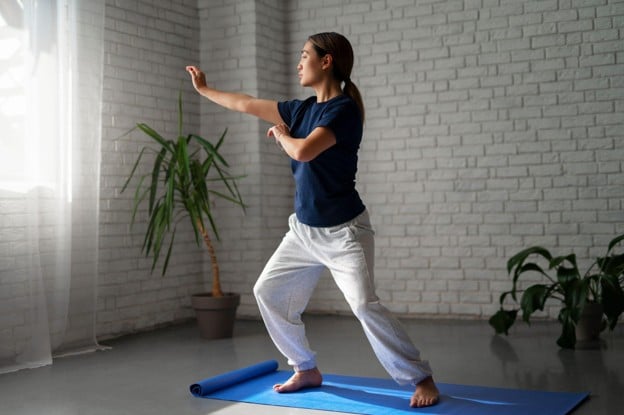
Why Learning the Principles Behind Each Movement Can Transform Tai Chi Practice

Students joining tai chi classes may initially focus on remembering postures and sequences, but meaningful practice goes much deeper. Understanding balance, breathing, weight transfer, precision, and martial applications can turn a memorized form into a more complete understanding of this traditional Chinese martial art.
Tai Chi is recognizable for its controlled, flowing movements, yet those movements are not simply choreography. Each transition involves decisions about posture, direction, coordination, and control. At Kunyu Mountain Shaolin Martial Arts Academy, instruction incorporates forms, breathing techniques, and martial applications, giving students opportunities to understand both how movements look and why they are performed.
Why Tai Chi Classes Should Teach More Than Forms
Learning a form is an important part of Tai Chi, but reproducing the external appearance of a movement does not necessarily mean understanding it.
Traditional instruction can encourage students to consider questions such as the following:
- Where should the body’s weight be positioned?
- How does one movement prepare for the next?
- What role does breathing play?
- How should the upper and lower body coordinate?
- What is the martial application of a particular posture?
- When should the body remain relaxed?
- How does balance change during transitions?
- Why is a movement performed in a particular direction?
These details give purpose to repetition.
Chinese Shaolin describes its teaching philosophy as going beyond movements and forms to include their attack-and-defense applications and cultural meaning. That approach can help students understand Tai Chi as a martial system rather than merely a collection of graceful motions.
Slow Movement Creates Opportunities to Study the Details
The deliberate pace commonly associated with Tai Chi allows practitioners to pay close attention to movement.
Instead of rushing from one posture to another, students can observe how the body changes throughout a transition. Small details involving foot placement, posture, alignment, and weight distribution become easier to recognize.
This process may reveal mistakes that are difficult to notice when movements are performed quickly.
For example, students may discover that they are
- Leaning unnecessarily.
- Holding excessive tension.
- Moving their arms independently from the body.
- Shifting their weight too early.
- Losing stability during transitions.
- Forgetting to coordinate breathing and movement.
Good tai chi classes can therefore make repetition more purposeful by encouraging students to refine how movements are performed rather than simply increasing the number of forms they know.
Balance Is Dynamic Rather Than Static
Balance in Tai Chi does not simply mean standing still without falling.
Practitioners repeatedly transfer weight between the legs while turning, stepping, raising the arms, changing direction, and transitioning between postures. The body’s center must continually adjust.
Understanding these transfers can improve the quality of an entire form.
Students gradually become more aware of when one leg is supporting most of their weight and when that weight needs to shift. They can also learn how foot placement and posture influence stability.
The Kunyu Mountain program identifies balance and precision among the deeper principles taught through its traditional Tai Chi instruction.
When students understand these principles, movements that initially feel like separate positions can begin to connect into a continuous sequence.
Breathing and Movement Work Together
Breathing is another element that can be overlooked when someone concentrates entirely on memorizing movements.
Tai Chi practice commonly combines controlled physical movement with deliberate breathing and mental attention. The National Center for Complementary and Integrative Health describes Tai Chi as involving gentle movements and postures together with controlled breathing and a meditative state of mind.
In structured tai chi classes, students can learn to avoid unnecessary breath-holding while developing a more coordinated rhythm between movement and respiration.
This does not mean forcing every breath into an unnatural pattern. Rather, breathing can become part of a relaxed, attentive approach to the form.
As students gain familiarity with a sequence, they often have more mental capacity to notice breathing, tension, posture, and other details that were difficult to consider when they were simply trying to remember what came next.
Martial Applications Give Movements Context
One of the biggest changes in understanding can occur when students learn what movements are intended to accomplish.
A posture that appears purely aesthetic may contain an offensive or defensive concept. Movements can involve ideas related to deflection, positioning, controlling an opponent, striking, or redirecting force.
Knowing the application can influence how a student performs the movement.
Instead of moving an arm to a position because that is what the form requires, the practitioner begins thinking about:
- Body positioning.
- Appropriate use of force.
Chinese Shaolins specifically characterizes Tai Chi Chuan as an internal form of Kung Fu and emphasizes the concept of using softer strength when responding to a stronger opposing force.
This martial context can make tai chi classes particularly interesting for students who want to understand the original principles behind the movements rather than practicing forms solely as exercise.
Relaxation Does Not Mean a Lack of Control
Tai Chi’s smooth appearance can sometimes create the impression that practitioners simply relax and allow their bodies to move loosely.
Effective relaxation is more precise.
Excessive muscular tension can make movement stiff, while insufficient structure can reduce stability and control. Students therefore work toward maintaining appropriate posture without creating unnecessary tension.
This distinction can take considerable practice to understand.
An instructor may repeatedly correct the same posture because the external position is only one part of the movement. The student must gradually learn how the movement should feel and how different parts of the body coordinate.
That is one reason direct instruction can be valuable. Subtle corrections may be difficult for beginners to identify on their own.
Repetition Changes When Students Understand Purpose
Repeating a form without understanding its principles can eventually become mechanical.
Once students know what they are trying to improve, repetition becomes a method of refinement.
One repetition might emphasize balance. Another may focus on breathing. Later practice might concentrate on transitions or the martial meaning behind particular movements.
Students can gradually work on:
- Smoother weight shifts.
- More stable posture.
- Better coordination.
- Reduced unnecessary tension.
- Clearer movement pathways.
- Greater awareness of applications.
- More consistent breathing.
- Stronger concentration.
The academy’s training approach reflects this progressive process. Its curriculum varies according to the length of a student’s stay, while Tai Chi and other internal martial arts can be studied alongside broader Kung Fu training.
This makes improvement less about collecting forms and more about developing greater quality within them.
Research Also Recognizes Tai Chi as a Mind-and-Body Practice
The broader understanding of Tai Chi as more than simple physical movement is also reflected in research-oriented health resources.
The National Center for Complementary and Integrative Health, part of the National Institutes of Health, describes Tai Chi as a centuries-old practice combining physical postures, gentle movements, controlled breathing, and mental focus. Research reviewed by NCCIH suggests Tai Chi may help improve balance and stability in some populations, although findings vary depending on the health condition and outcome studied.
This combination of physical and mental attention helps explain why understanding the principles behind movements can matter. Students are not simply moving their arms and legs through predetermined positions; they are learning to coordinate multiple elements simultaneously.
Push Hands Can Make Abstract Principles More Tangible
Partner exercises can provide another way to understand principles that may initially seem abstract.
Chinese Shaolin’s Tai Chi training materials show students practicing push hands in addition to forms and other exercises.
Working with another person can help practitioners explore concepts such as sensitivity, positioning, balance, and responding to external pressure. A movement practiced alone may make more sense once the student experiences how its underlying principle functions during interaction.
This can also reveal weaknesses that solo practice may hide.
A student may believe their stance is stable until pressure is introduced, for example. Partner training provides immediate feedback and can encourage practitioners to refine structure rather than relying only on how a movement appears.
Traditional Instruction Can Preserve the Meaning Behind the Art
Tai Chi has spread internationally and is practiced for many different reasons. Some people are interested in martial arts, while others are attracted to its controlled movement, cultural history, or mind-and-body elements.
For students interested in traditional practice, learning the meaning behind forms can provide an important connection to the art’s martial roots.
At Kunyu Mountain, tai chi classes form part of a broader traditional Chinese martial arts environment. The academy teaches international students and incorporates martial applications alongside forms and breathing techniques.
Studying movements within that wider context can help students understand how individual techniques relate to larger principles found throughout Chinese martial arts.
Progress Is About Depth as Well as Difficulty
It can be tempting to measure martial arts progress by the number of forms learned or the complexity of techniques performed.
Tai Chi offers another way to think about advancement.
A student can return to a familiar movement repeatedly and continue discovering details involving balance, relaxation, timing, breathing, coordination, and application. A basic posture performed with deeper understanding may represent more meaningful progress than an advanced sequence performed without control.
This is why foundational instruction remains valuable even as practitioners gain experience.
Beginners need principles to build reliable habits. More experienced students need those same principles to refine increasingly subtle aspects of their practice.
Understanding Turns Movement Into Practice
Tai Chi’s flowing movements may be what first attracts attention, but the principles underneath them give the practice its depth. Balance, breathing, controlled weight transfer, relaxation, concentration, and martial applications help explain why movements are performed rather than simply showing students what comes next.
Well-structured tai chi classes can encourage students to develop this deeper understanding through instruction, correction, repetition, forms, and practical applications. Over time, movements that once required conscious memorization can become opportunities to explore increasingly subtle aspects of coordination and control.
Learning a sequence provides the framework. Understanding what each movement is designed to teach is what can transform that sequence into a deeper martial arts practice.